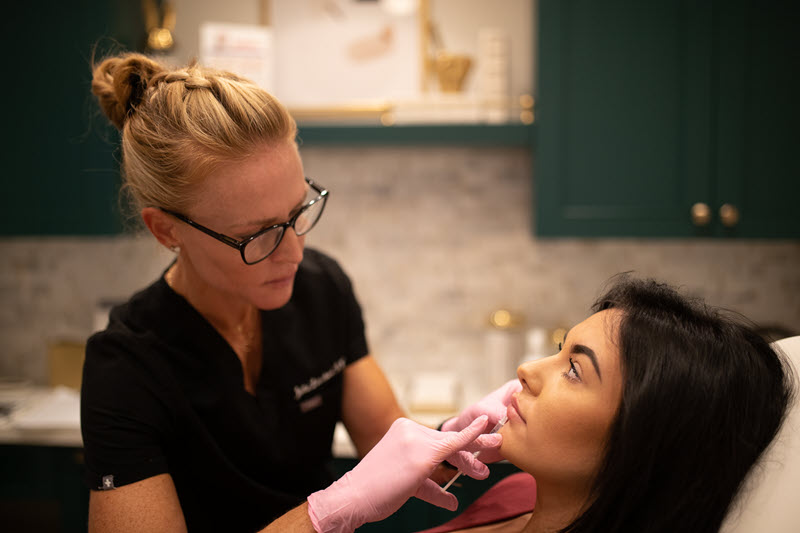
A pebble chin is a cosmetic concern, not a medical condition, and it doesn’t indicate an underlying health problem. It is also called dimpled, cobblestone, or orange peel chin. This article explains why it occurs, who is most likely to get it, and how to smooth it with treatments we offer at Vibrant Skin Bar.
Kristina Cadwell
October 28, 2026
·
9 min read
Is Pebble Chin Normal?
A pebble chin is a chin whose skin looks bumpy, dimpled, or puckered. It is common, not harmful, and responds well to treatment.
A small muscle called the mentalis sits at the front of the lower jaw and attaches directly to the chin skin. Each time it contracts to push the lower lip up or close the mouth, it pulls the skin inward. In some people, that pull creates visible dimples.
Some people only notice the uneven texture when they talk, purse their lips, or frown. Others see it even when their face is relaxed.
What Are the Types of Pebble Chin?
There are two types of pebble chin.
Dynamic pebble chin appears only when the mentalis muscle contracts. Your chin looks smooth at rest, but dimples show up when you speak, smile, pout, or press your lips together. The muscle is the main driver here.
Static pebble chin is visible even when your face is completely relaxed. Years of repeated muscle pull, combined with collagen loss and thinning of the fat under the skin, leave lasting changes in texture.
The distinction matters because the two types respond to different treatments. Muscle-driven dimpling calls for a muscle-relaxing approach, while textured skin needs help with collagen and volume. Over time, dynamic dimpling can become static, so it helps to address it early.
Who Is Most Likely to Have Pebble Chin?
Anyone can develop a pebble chin, but the following factors increase its likelihood:
Strong or highly active mentalis muscle.
Recessed or underprojected chin.
Aging-related collagen and facial fat decline.
Smoking and sun exposure, which speed up collagen breakdown.
What Causes a Pebble Chin?
Most cases result from a combination of the factors below.
Overactive Mentalis Muscle
This is the leading cause of a dimpled chin. Because the mentalis attaches to the skin of the chin, a muscle that contracts too often or too forcefully repeatedly pulls on the skin and creates dimples.
Collagen and Fat Loss
As we age, skin loses collagen and the fat cushion beneath it thins. Without this padding, the muscle pull shows more clearly on the surface. This is why a pebble chin often becomes more noticeable with age.
A Recessed or Underprojected Chin
When the chin bone sits further back, the soft tissue gets less support underneath. Clinicians have observed that in some patients the mentalis sits high on the chin and works harder, which can exaggerate dimpling.
Repeated Expressions
Puckering the lips, tensing the chin when concentrating, or holding a pout engage the mentalis. Doing this thousands of times a week keeps the muscle active and can increase dimpling over time.
Sun Damage and Smoking
UV exposure and tobacco break down collagen and elastin faster than normal aging. They don’t cause a pebble chin on their own, but they can make the skin less resilient to the muscle’s pull.
Can Pebble Chin Be Prevented?
Pebble chin cannot be prevented because muscle activity, bone structure, and aging cause the condition. However, you can slow the process.
Refrain from chin-tensing activities, such as constant lip pursing or clenching the chin.
Consider early, low-dose muscle relaxation if you see dynamic dimpling.
Avoid rapid weight loss, which can thin the fat that cushions the chin.
How Do I Get Rid of Pebble Chin?
The right treatment for pebble chin depends on the cause. At Vibrant Skin Bar, your provider will examine your chin at rest and in motion, and build a customized treatment plan. Here are the main options.
Botox, Dysport, and similar neurotoxin injections block the nerve signal that tells the mentalis to contract. As the muscle relaxes, it stops tugging the skin into dimples. This is the primary option for dynamic pebble chin.
When do results become visible? Effects begin around day three and peak at about day 14. We schedule a free two-week follow-up at the peak to see the full result and fine-tune if needed.
How long do results last? Typically three to four months. With regular treatment, many clients stretch visits to four or five months apart.
Skip alcohol, ibuprofen, and blood-thinning supplements for 24 hours.
Avoid facials, facial massage, and laser treatments for 14 days.
Avoid pressing or rubbing the treated area.
How much does it cost? Neuromodulators are priced per unit. At Vibrant Skin Bar, Botox and Xeomin are $14 per unit, Dysport is $4.67 per unit, and Daxxify is $7 per unit. Published chin protocols use 8 to 15 units of Botox, totaling about $110 to $210 per session at our current price.
Is it safe? Precise placement and conservative dosing keep that risk low, which is why we recommend going to an experienced injector.
Note: Learn more about Botox aftercare and how to ensure safe, lasting results.
Dermal Fillers
Fillers work best when a recessed chin is part of the problem. Adding projection gives the soft tissue more support, so the mentalis strains less. Two hyaluronic acid fillers are FDA-approved for chin augmentation: Juvéderm Voluma XC and Restylane Defyne. Collagen-stimulating fillers like Radiesse and Sculptra can also improve volume and skin quality in the lower face. See our guide to the best filler for the jawline.
When do results become visible? Hyaluronic acid fillers show their result right away, with final settling after about two weeks. Sculptra builds gradually, typically over three sessions spaced a month apart.
How long do results last? Restylane, Juvéderm, and Radiesse last 12 – 18 months, and Sculptra lasts up to two years. Hyaluronic acid fillers can be dissolved if needed.
Is there special aftercare?
Avoid intense physical activity for 48 hours.
Don’t apply pressure to the chin for a few days.
Use gentle skincare products.
Apply a cool compress to reduce swelling.
Drink plenty of water.
Mild bruising, swelling, or lumps are common and typically settle within about two weeks. Learn more about how to treat your skin after dermal fillers.
How much does it cost? At Vibrant Skin Bar, Restylane Defyne is $699 per syringe, Juvéderm Voluma, Volux, and Radiesse are $825 per syringe, and Sculptra is $900 per vial. The number of syringes depends on how much projection you need, and your provider will estimate it during your consultation.
Is it safe? Fillers are generally well tolerated when placed by an experienced injector, and mild bruising and swelling are the most common effects. A rare but serious risk is a filler blocking a blood vessel, so choose a provider with strong knowledge of facial anatomy.
Note: Learn how Botox and fillers differ, and how providers pair them for more effective rejuvenation. Explore Juvéderm and Restylane fillers and the cosmetic concerns they address.
Microneedling and Revita Pen
Microneedling creates controlled micro-injuries that prompt the skin to rebuild collagen. The treatment improves skin quality by softening fine lines and uneven texture but does not relax the muscle. That is why it pairs well with a neuromodulator.
Revita Pen is an alternative treatment to microneedling. It uses a no-needle device to infuse serums such as exosomes or vitamin A into the skin for a similar texture boost.
When do results become visible? Most clients notice a glow within one to two weeks, with collagen improvements continuing over the following weeks. A series of treatments provides the best results.
How long do results last? Improvements last for several months with good maintenance.
Is there special aftercare? Expect redness for 24 to 72 hours and light flaking on days two to five. Avoid strenuous exercise, heat, sweating, and makeup for 24 to 48 hours. Avoid facials and active skincare ingredients for seven to 14 days and wear SPF daily.
How much does it cost? Microneedling starts at $400 per treatment, depending on the formula. Add-ons such as exosomes cost $450, and PRF costs $600. Revita Pen treatments range from $225 to $375.
Combination Treatment
Because a pebble chin often has multiple causes, combining treatments usually delivers the smoothest, longest-lasting results. A typical plan includes relaxing the muscle with a neuromodulator, restoring projection with filler, and refining the skin with microneedling. Our jawline contouring guide shows how chin and jaw treatments are often planned together.
What About Surgery?
For a significantly recessed chin, a surgeon may recommend a chin implant or a procedure that repositions the chin bone. These are more invasive and are usually reserved for larger structural modifications. Your consultation will help determine whether non-surgical options will be enough.
How to Choose the Right Treatment for Pebble Chin?
Use these guidelines as a starting point and discuss options with your provider.
If dimples appear only when you move your chin, a neuromodulator is usually the best first step.
If a dimpled texture is visible at rest, add microneedling or Revita Pen to improve the skin.
If your chin looks small or recessed in profile, fillers can add projection and support.
For longer intervals between visits, ask about longer-acting options and collagen-stimulating treatments.
At your consultation, the provider will consider how your chin moves, how it looks at rest, your profile, your skin quality, your budget, and how much downtime fits your schedule.
Consultations at Vibrant Skin Bar are complimentary, last about 30 minutes, and end with a written plan and price. Members also save on treatments through our membership program.
Pebble Chin FAQ
Here are quick answers to the questions we hear most about pebble chin.
Is Pebble Chin the Same as Cleft Chin?
No. A cleft chin is a vertical groove down the middle of the chin that comes from the shape of the jawbone beneath it, and it is typically an inherited trait. A pebble chin is a skin texture issue caused by muscle pull and skin aging.
Pebble Chin vs. Chin Wrinkles
Chin wrinkles usually refer to lines, such as the horizontal crease between the lower lip and the chin. Pebble chin refers to the bumpy, dimpled texture across the chin pad. The same muscle causes both, which is why they often appear together and respond to similar treatments.
Does Pebble Chin Get Worse with Age?
Often, yes. As collagen and fat decline, the skin has less cushioning and resistance, so the muscle’s pull shows more. Dynamic dimpling can also become static over time. The good news is that treatment at any age can improve pebble chin.
Can Skin Care Remove Pebble Chin?
Skin care can improve skin quality but cannot remove a pebble chin driven by muscle activity. Sunscreen, moisturizer, and retinoids support collagen and hydration and can soften mild texture over time.
Can Pebble Chin Be Removed Permanently?
Not with non-surgical treatments, as their effects are temporary and require maintenance. Surgical changes to the chin bone last longer but are invasive and not right for most people with a pebble chin.
Conclusion
A pebble chin is common, harmless, and treatable. The best treatment depends on the cause. Neuromodulators relax the muscle, fillers add support, and microneedling improves skin texture.
PA Kristina Cadwell graduated from Arizona State University with a Bachelor of Science degree in Biology. She then completed the Physician Assistant program at A.T. Still University graduating with a Masters of Medical Science degree. Kristina has been working in the Aesthetic Medical field for over 15 years. She is certified in neurotoxin cosmetic injection, dermal fillers, laser therapy, chemical peels, and ultrasound. She is known for producing natural results and has extensive knowledge in nutrition, hormone balancing, microbiome health, diet and exercise. Her latest endeavor is the Vibrant Skincare Line, a microbiome-friendly line of skincare that works with your body. Her passion and the reason she does everything she does? Helping you achieve vibrant skin from the inside out.