Dermal fillers are among the most popular skin-rejuvenating treatments for restoring lost volume, smoothing wrinkles, and enhancing facial contours. While effective, safe, and minimally invasive, they are not entirely without risk.
Most dermal filler side effects are mild and temporary, however, a bluish discoloration known as the Tyndall effect is more complex and may require targeted correction.
This article explores the Tyndall effect after dermal fillers and effective strategies for its prevention and treatment.
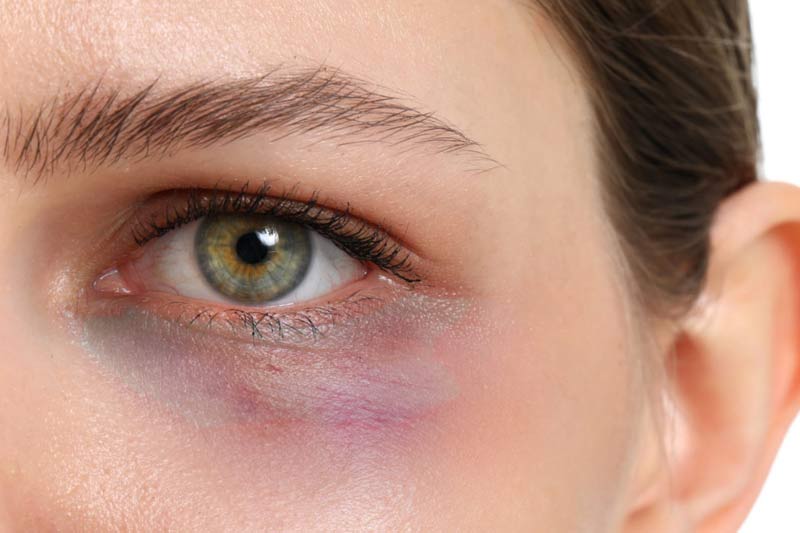
What Is the Tyndall Effect after Dermal Fillers?
The Tyndall effect is when the skin appears bluish, gray, or “bruised” after a filler treatment. This unusual phenomenon is usually caused when the filler is injected superficially or an improper amount is administered to facial areas where the skin is thinner and more translucent (e.g., under the eyes or around the mouth).
Unlike bruising, this bluish discoloration does not fade on its own and may require corrective treatment. It is often associated with hyaluronic acid (HA) fillers, which are commonly used in more sensitive areas due to their low viscosity and softer texture.
What Is the Science Behind the Tyndall Effect?
When the filler is placed too close to the surface of the skin, it can interact with light in a way that creates a bluish tint, called the Tyndall effect.
Light that enters the skin contains different wavelengths. Shorter wavelengths, such as blue light, are scattered more easily by the filler particles. Longer wavelengths, such as red light, tend to pass through more directly. Because the filler is placed on the surface, this scattering of blue light is reflected back to the eye, giving the area a bluish or grayish appearance. The other wavelengths remain less visible.
When Does the Tyndall Effect Occur after Fillers?
The Tyndall effect may be visible immediately after the treatment or appear after several days. If not addressed, it may persist for months or even years.
These are the most common causes:
- Improper technique – If the filler is injected too close to the surface, especially where the skin is naturally thin and translucent, the area may take on a bluish-gray hue. This is the most common cause of the Tyndall effect.
- Wrong filler type – Dermal fillers with larger particles or greater density, and non-animal stabilized HA (NASHA) gels, tend to cause this effect more often. Softer, less particulate, and more transparent HA fillers reduce the risk.
- Use of highly hydrophilic fillers - Some hyaluronic acid fillers attract more water, causing swelling and making the filler more visible under thin skin.
- Overfilling – Injecting larger doses can lead to lumps, bumps, and discoloration because excess filler can push the product upward toward the surface.
- Incorrect placement – Placing the filler at the wrong angle or depth may lead to filler migration and inadvertently produce a light-scattering effect.
- Skin thickness – Areas with thinner, more delicate skin, such as tear troughs, are more prone to developing the Tyndall effect because there is no fat between the skin and muscle for proper injection placement.
What Areas Are Prone to the Tyndall Effect after Dermal Fillers?
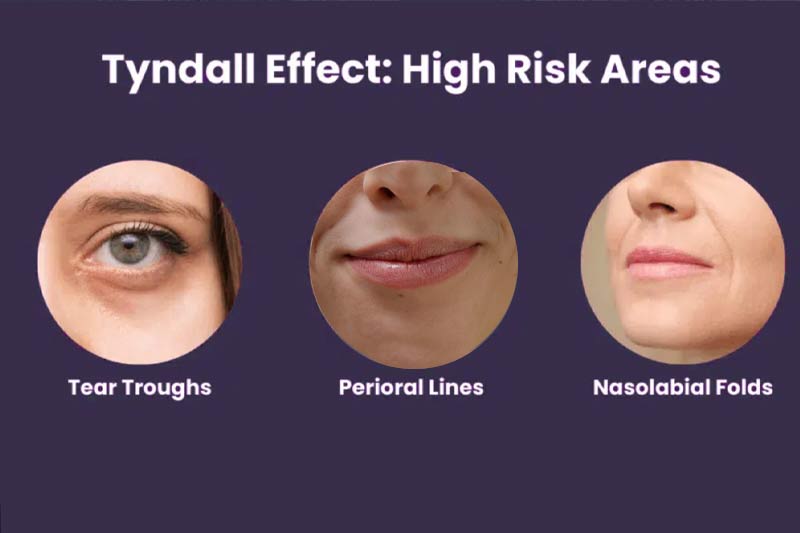
These areas are more prone to the Tyndall effect due to minimal fat and thin, translucent skin:
- Under the eyes
- Nasolabial folds
- Perioral lines (smoker’s lines)
- Lips and around the mouth
Additionally, aged skin is generally more susceptible to this undesirable effect, as it is thinner due to reduced collagen and elastin.
Note: Discover the best filler for the under-eye area.
How to Recognize the Tyndall Effect after Dermal Fillers?
It is vital to distinguish this unwanted outcome from other side effects before taking the next step. The Tyndall effect may be mistaken for bruising, swelling, or post-inflammatory hyperpigmentation if not understood properly.
These are the most common indicators of the Tyndall effect:
- The skin takes on a bluish, grayish, or slightly purplish tint.
- The skin may be slightly raised or lumpy at the injection site.
- Unlike bruises that change color and fade, this discoloration is cool-toned and does not fade over time.
- It is usually more noticeable in natural daylight because sunlight contains more blue light, which makes the bluish scattering effect more pronounced.
- The bluish hue is only visible at the injection site, exactly where the filler was placed.
- The spot is not sensitive to touch and is generally painless.
How Long Does the Tyndall Effect Last after Fillers?
If left untreated, the Tyndall effect may last for months or even years. Unlike temporary bruising and swelling that resolve within 1 to 2 weeks, this side effect does not subside on its own and typically requires intervention.
Can the Tyndall Effect After Dermal Fillers Be Permanent?
Since HA fillers are not permanent, neither is the Tyndall effect. Injected hyaluronic acid naturally dissolves over time, so the Tyndall effect fades as the body gradually degrades the product.
This process may take 6 to 18 months, depending on the filler type, the amount of product, and the patient’s metabolism.
How to Prevent the Tyndall Effect after Dermal Fillers?
There are several effective strategies you can use to prevent this unwanted outcome.
Reputable Provider
Choose a board-certified, qualified injector with years of experience in administering HA fillers. A dermal filler professional will tailor their approach and technique based on each patient’s unique anatomical features, filler type, and treatment area.
Contact our skin experts at Vibrant Skin Bar to schedule your first appointment.
Micro Fillers
Micro fillers are full-face HA-based injectables that combine tiny amounts of soft hyaluronic acid with vitamins, minerals, amino acids, and antioxidants. The advanced microdroplet technique emphasizes the precise, strategic placement of small amounts of filler, enabling even distribution of the product and minimizing the risk of concentrating it too close to the surface.
RHA Filler
Resilient hyaluronic acid (RHA) fillers are designed to be more flexible and dynamic and to closely mimic naturally occurring hyaluronic acid.
Their long-chain molecular structure enables seamless integration into the skin, reducing the likelihood of dense, superficial deposits that create the light-scattering effect. RHA fillers are also less hydrophilic, meaning they attract less water and are less likely to cause swelling that increases the visibility of the filler under the skin.
Fat Transfer
Fat transfer, or fat grafting, is a medical procedure that involves surgically removing excess fat tissue from one part of the body, such as the hips, thighs, or stomach, and transferring it to another area that needs volume. This procedure is performed by a plastic surgeon in a professional medical setting to rejuvenate the under-eye hollows, restore volume in the cheeks or temples, and enhance the definition and contours of the jawline.
How to Get Rid of Tyndall Effect from Dermal Fillers?
Depending on the urgency and the visibility of the bluish hue, you can either opt for corrective treatment or wait for the Tyndall effect to fade naturally.
Dissolve the Filler with Hyaluronidase Injections
HA-based dermal fillers can be dissolved with an enzyme called hyaluronidase, which breaks them down, allowing the body to absorb and eliminate them.
This is the most effective way to eliminate the Tyndall effect and can be safely performed within 24 hours. However, it is best to wait 2 weeks to ensure the bluish discoloration is not due to temporary bruising or swelling.
Dosage varies depending on the amount of injected HA filler and whether the patient wants to remove all the filler or just treat a specific area. Studies have shown that hyaluronidase can be used at any time and remains effective 63 months after the initial injection.
Ultrasound-Based Hyaluronidase Treatments
Ultrasound-guided hyaluronidase treatment is the most reliable method for dissolving fillers and eliminating the Tyndall effect.
When providers perform hyaluronidase injections under ultrasound guidance, they locate the filler’s exact position, dissolving only the superficial deposit causing the Tyndall effect while keeping the deeper, correctly placed filler.
Schedule a Laser Treatment
Certain laser treatments can reduce the bluish tint caused by superficial filler placement. A 1064-nm Q-switched Nd:YAG laser can break down or alter the filler, targeting light reflection and improving skin clarity. Unlike hyaluronidase injections, laser treatments cannot completely reverse the Tyndall effect, but they can minimize it in mild cases.
Radiofrequency (RF) Treatments
Radiofrequency (RF) treatments heat and soften the injected material, accelerating the substance's natural breakdown and improving skin thickness, making discoloration less visible.
RF microneedling (Vivace) can be used to shrink firm, non-inflammatory nodules and shorten the lifespan of the filler. RF indirectly mitigates the Tyndall effect by accelerating the natural degradation process. It can also be safely used in the delicate, under-eye area.
Massage the Treated Area
Immediate, firm massage may flatten and disperse excessive or superficially placed filler, allowing it to settle into deeper, less visible layers and reducing the blue hue. However, this method is effective only when performed by a skilled, certified injector shortly after the filler injection.
After 4 to 5 days, massage alone is unlikely to resolve discoloration, and more effective management strategies are required.
Makeup Correction
A color-correcting product or tinted sunscreen can temporarily neutralize blue and gray tones in the skin. Use only broad-spectrum, mineral-based sunscreen with SPF 30 and higher to protect the skin from UV radiation and temporarily hide the discolored area. This is recommended only for mild to moderate discoloration caused by the Tyndall effect.
Note: Learn what to do if fillers go wrong and how to prevent this from happening.
Proper Aftercare
Follow your provider’s recommended aftercare protocol to enhance results and accelerate healing. While this does not address the issue itself, appropriate post-treatment care can significantly reduce swelling and bruising, allowing you to better assess the extent of the Tyndall effect and determine the most appropriate next step.
Is the Tyndall Effect after Dermal Fillers Dangerous?
The Tyndall effect after dermal fillers is not considered dangerous or a medical emergency. It is usually painless, unless accompanied by lumps that may temporarily sensitize the treated area.
Do not confuse the Tyndall effect with vascular occlusion, a serious filler complication that can appear as a blue or purple discoloration under the skin and requires immediate medical attention. If you are unsure about your symptoms, seek medical attention to assess your skin condition.
Conclusion
The bluish discoloration, known as the Tyndall effect and caused by superficial filler placement, is not dangerous but can be concerning, especially if left untreated for months. Luckily, there are many effective preventive and management techniques that can minimize risk, mitigate symptoms, or eliminate the problem altogether.
Choosing an experienced, qualified injector is the first step toward ensuring optimal results. Contact our filler professionals at Vibrant Skin Bar to learn more about dermal fillers and schedule your first appointment.